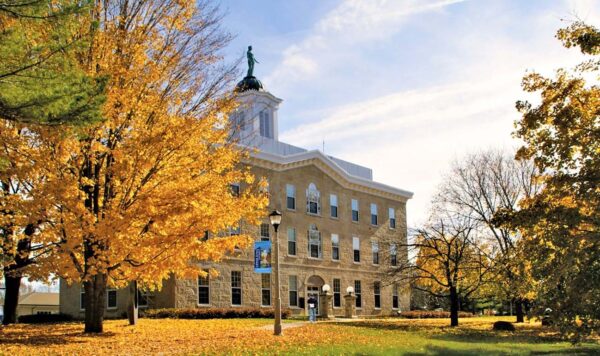



Fayette Campus Financial Assistance
Upper Iowa University provides financial assistance to more than 99 percent of students on the Fayette Campus.
Assistance comes in three forms:
- Gift aid is usually called “grants” or “scholarships” and does not have to be repaid. Grants are usually based on financial need, and scholarships tend to be based on academic achievement or special talents. Merit scholarships for incoming freshmen at the Fayette campus, which can be renewed annually, range from $17,000 to $5,000 per year. Merit scholarships are also available to transfers and international students at the Fayette campus, which can be renewed annually, range from $12,000 to $7,500 per year. Visit the Scholarships section of the website for details.
- Loans are made to students at low interest rates and must be repaid, generally after students complete their education.
- Work opportunities are awarded to students through special programs providing part-time jobs when classes are in session or during vacations.
Your gift aid must be applied to the University charge and cannot result in a cash overpayment to you. Institutional financial aid is based on your part-time or full-time enrollment status.
Once you have applied and been accepted to Upper Iowa and have submitted the FAFSA, you will automatically be considered for financial aid.
Grants & Loans
Federal Pell Grants are funded by the federal government and are normally available for four years of undergraduate work, with awards ranging from $1,176 to $5,550 per year. Recipients must be U.S. citizens or eligible noncitizens and must be enrolled at least half-time (six credits per semester).
Federal Supplemental Education Opportunity Grants (FSEOGs) are available for students with exceptional financial need. Awards range from $200 to $4,000 per year if funding permits. The grants are funded by the federal government. Priority deadline for the FSEOG is March 1.
TEACH Grant Upper Iowa University participates in the TEACH Grant Program. Students must meet the defined general eligibility requirements. Specifics include the completion of the TEACH Grant Agreement to Serve and Counseling at http://teach-ats.ed.gov which includes terms and conditions of the grant service obligations. Additional counseling is required with our Fayette campus and center staff prior to being awarded eligibility. More details can be found at https://teach-ats.ed.gov/ats/index.action.
Federal Perkins Loans are funded by the federal government and Upper Iowa University, and are available to U.S. citizens and eligible noncitizens. The amounts awarded vary, depending on financial need, but cannot exceed $4,000 a year. No interest is charged, nor is payment required, while the borrower is enrolled at least half-time. Interest of 5 percent per year begins nine months after the borrower ceases to be enrolled at least half-time, and repayment must be completed within a 10-year period.
Federal Stafford Loans To qualify, you must be a U.S. citizen or eligible non-citizen. Subsidized Federal Stafford Loans are for those who show financial need. The interest is paid by the federal government while the recipient is enrolled at least half-time. Unsubsidized Federal Stafford Loans are for those who do not show financial need. The interest is paid by the recipient while enrolled at least half-time. The annual combination of both subsidized and unsubsidized Federal Stafford Loans may not exceed $5,500 (dependent) or $9,500 (independent) for the freshman year, $6,500 (dependent) or $10,500 (independent) for the sophomore year, and $7,500 (dependent) or $12,500 (independent) for junior and senior years. The aggregate lifetime maximum for both loans may not exceed $23,000 (dependent) or $57,500 (independent) for undergraduate study. Repayment begins six months after the recipient graduates or withdraws from school. The interest rate is variable based on the 91-day T-Bill auctioned prior to June 1 with the following additions: 1.7 percent during in-school, grace and deferment periods and 2.3 percent during repayment. The rate cannot exceed 8.25 percent. Disbursement of loan proceeds is in two equal payments.
Federal PLUS Loan Program. Parents of dependent students may borrow funds to pay for the students’ educational costs. The maximum loan per year may not exceed the estimated cost of attendance less financial assistance. The repayment period begins within sixty (60) days after the loan is disbursed. The interest rate is the 52-week T-Bill rate plus 3.1 percent and is capped at 9 percent. Disbursement of loan proceeds will be in two equal payments.
McElroy-Upper Iowa Student Loans are intended to serve Upper Iowa students and are made possible by funds donated by the Ralph J. McElroy Trust, Waterloo, Iowa. The loan can range from $500-$2,500 per year, with a total aggregate not to exceed $7,500 to an individual. Interest of 4 percent per year begins six months after the borrower ceases to be enrolled at least half-time, and repayment must be completed within a five-year period. The loan applicant must be a U.S. citizen, currently enrolled as a full-time student and possessing a cumulative grade point average of at least 2.25, based upon a minimum of one semester of full-time student status at Upper Iowa University.
Sample repayment schedules are available in the Financial Aid Office.
Work Opportunity
Federal Work Study is funded by the federal government and Upper Iowa University jointly. To be eligible, students must be U.S. citizens or eligible non-citizens and must receive the opportunity through financial aid awards. The maximum amount of earnings is determined by the students’ financial need. The average job requires 6-8 hours per week, with the federal minimum wage as the base pay. Every effort is made to match the students’ abilities, experience and class schedule with appropriate positions.
Iowa Tuition Grants are available for residents of Iowa who qualify based on financial need. Funded by the State of Iowa, the statutory maximum award is $4,000 for each year of full-time undergraduate study (12 or more credits per semester). Priority deadline for the Iowa Tuition Grant is July 1.
Iowa Grants are designed for exceptionally needy undergraduate Iowa students attending NCA-accredited colleges and universities in the state of Iowa. These grants, available for full- and part-time students, range from $100 to $1,000. Due to limited funding, only a selected number of needy applicants will be assisted.
Iowa National Guard Education Benefits are currently available to Guard members. For application forms and additional information, contact a Guard personnel officer.
Alternative Loans
There are situations in which the gift aid and Stafford Loan eligibilities that students receive as part of their financial aid packages are not sufficient to cover the costs associated with attending college. In these situations, students may wish to pursue private, credit-based alternative loan funds.
This information is intended to serve as a starting point for students who wish to pursue private, credit-based alternative loan options. It is not an endorsement for any credit-based loan program.
What is a private, credit-based alternative loan?
A private credit-based alternative loan is a loan that students can use to help them "fill the gap" between their educational expenses and financial aid that is awarded to them through gift aid and the Stafford Loan program.
How is a private, credit-based alternative loan different than a Stafford Loan?
Stafford Loans are guaranteed loans. This means that students can obtain these educational loans regardless of their credit history. Some of the benefits of the Stafford Loan program include:
- No interest of Subsidized Loan funds while the student is enrolled at least half time.
- Possibility of deferment and/or forbearance of loan payments.
- Lenders tend to be more willing to work with students if they experience financial hardships during repayment.
How do I know if I need a private, credit-based alternative loan?
When a student completes the Free Application for Federal Student Aid (FAFSA), the Financial Aid Office will use that information to determine his/her eligibility for grants and Stafford Loans. Once you receive your award information, you will be able to subtract your costs from the amount of grants and other gift aid and Stafford Loans that have been awarded to you. If there will be a balance due that you cannot pay out-of-pocket, you may wish to consider a private, credit-based alternative loan program.
If I decide that I want to pursue a private, credit-based loan, how do I know how much to request?
Determine your cost of classes (and room and board if you are a Fayette Campus student). You would then want to add any books, travel expenses, or other educational expenses that you expect to incur. You will want to subtract the amount of financial assistance that was awarded to you in gift aid and Stafford Loan funds. That will be the amount that you would owe for your educational expenses. This would provide you with a good estimate of the amount of loan funds that you may wish to request.
What happens if I am approved for a private, credit-based alternative loan?
Once you have been approved by a lender for a private, credit-based alternative loan, the lender will notify the Financial Aid Office. The amount of credit-based alternative loan funds that you are eligible to borrow will then be determined by subtracting the gift aid and Stafford Loan funds that you are receiving from the budget that was used to determine your financial aid eligibility. The lesser of your request or the remaining budget will be the amount that the certification of your private, credit-based alternative loan will be completed for.
There are many lenders who offer private, credit-based alternative loan funds for educational purposes.
Below is a list of considerations when determining which lender you wish to pursue a private, credit-based alternative loan with:
- Will I be required to obtain a cosigner?
- What is the origination fee (percentage of the amount borrowed charged for issuing the loan to you by the lender)?
- What are the interest options? Is the interest a fixed rate or adjustable rate?
- Can I make payments on the loan while I am still enrolled in school
- Are there any penalties for early repayment of the loan?
- Are there any incentives for making repayment on time or having payments automatically deducted from a checking or savings account?
The most important questions that you should ask yourself before pursuing a private, credit-based alternative loan program:
- Do I really need to borrow these funds?
- Will I be able to make the monthly payments on this loan when I go into repayment?
Students are free to pursue private, credit-based alternative loan funds with the lender of their choice.
Veterans' Benefits
Upper Iowa University is approved by the Department of Education of the State of Iowa to certify qualifying learners to receive veterans' benefits.
For additional information on applying for veterans' benefits, changing your place of training or how courses are certified, contact the Veterans' Administration certifying official at your program office. It is extremely important that you indicate on your registration for each class that you want the course certified for veterans' benefits.
Upper Iowa University will also notify the Veterans Administration of any change in status including administrative withdrawal or withdrawal from a course. With a change in status, the learner may be required to refund benefits. Student reimbursement will be calculated by the VA and is determined separately than any eligible refund under Upper Iowa University's policy.